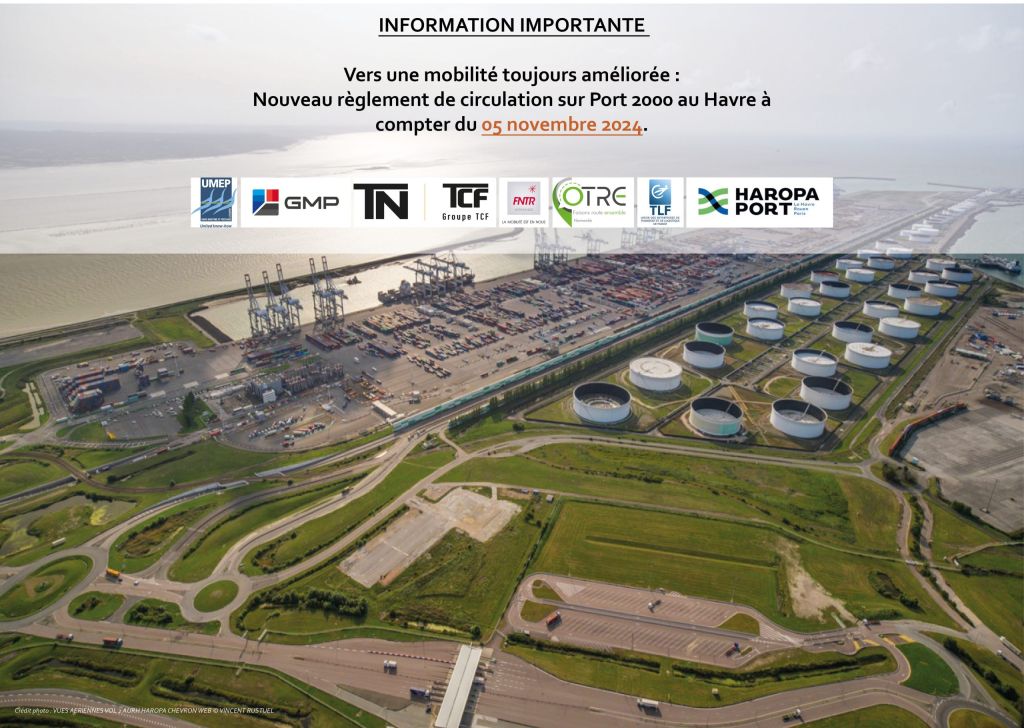
Press release – Towards ever-improving mobility: New traffic regulations at Port 2000 in Le Havre from 5 November 2024

LE HAVRE, 29 October 2024
UMEP, the cargo handling operators based at Port 2000 (Générale de Manutention Portuaire and TN Groupe TCF) and the road hauliers’ federations FNTR Normandie, OTRE and Union TLF Normandie are pooling their expertise within a monitoring committee dedicated to ensuring the smooth flow of road traffic at Port 2000 in Le Havre, in partnership with HAROPA PORT.
As part of their joint efforts and in anticipation of the increase in freight traffic at the Port of Le Havre, the federations have jointly drafted and co-signed a new port regulations document.
A community-based framework
In order to curb road congestion at Le Havre’s port terminals and continue their commitment to the continuous improvement of operational models, the organisations sought to consolidate, within a community framework of best practice, the measures undertaken by the port facilities located at Port 2000, drawing on their respective rendezvous systems for the handover of sea containers to road hauliers commissioned by their clients.
A new operating method to improve traffic flow from 5 November 2024
Under the auspices of UMEP, together with its full and associate members: GMP, TN – GROUPE TCF, FNTR, OTRE, TLF, and with technical support from HAROPA PORT – Le Havre Regional Directorate, it has been decided to require road hauliers to enter their appointment number on the port terminal’s booking system when passing through the François 1er gate.
Hauliers arriving outside their authorised time slots will therefore be required to leave the Port 2000 site so as not to hinder the smooth passage of hauliers arriving within their booked time slots.
Hauliers who need to leave the Port 2000 site will find a dedicated waiting area for heavy goods vehicles just before the François 1er Gate, at the entrance to Port 2000. This procedure and the measures it entails are set out in the annex to the general terms and conditions of use for the respective appointment systems of the terminal operators based at Port 2000.
In the event of non-compliance with EU regulations or the traffic regulations applicable within the Le Havre port area, the Port 2000 Traffic Flow Monitoring Committee – acting in an advisory capacity – may recommend proportionate measures. These measures are defined in accordance with the legislation in force and will be implemented through fair and transparent procedures.
The initial tests have proved successful for all parties involved, and the system will be rolled out gradually to allow everyone to integrate it into their day-to-day operations.
The technical equipment for entering the appointment number at the François 1er gate and the road signs indicating the introduction of this new system have been installed and funded by HAROPA PORT.
Resolutely looking to the future
This agreement reinforces best practice at the Port of Le Havre and will complement other commendable initiatives that promise positive benefits for every player in the supply chain, paving the way for an increased flow of goods and opportunities!
Press contact: contact@umep.org
The Signatories:
UMEP: www.umep.org
GMP: www.gmportuaire.fr
TN Groupe TCF: www.tnterminals.com
FNTR Normandy: www.fntr.fr/normandie
OTRE: www.otre.org
Union TLF Normandie: www.e-tlf.com/nos-regions/tlf-normandie
HAROPA PORT: https://www.haropaport.com/fr
* The François I Gate is the sole road access point to Port 2000, where temporary and permanent passes – issued individually to lorry drivers collecting or delivering goods at the Port 2000 terminals – are scanned. This access point is shared by all the port terminals located at Port 2000. Both its staff and technical resources are managed by the port authority (HAROPA PORT – Le Havre Regional Directorate).
Access the PDF version: Press release – Traffic Flow at Port 2000, Le Havre
Photo credit for illustration: AERIAL VIEWS VOL 2 AURH HAROPA CHEVRON WEB © VINCENT RUSTUEL