
FuelEU: The regulation came into force on 1 January 2025
The EU’s FuelEU Regulation, adopted in July 2023, which sets maximum limits on greenhouse gas emissions, came into force on 1 January 2025.
It applies to all ships of more than 5,000 gross registered tonnes, regardless of their flag, which call at European ports.
The text specifies that it applies:
– to all ships with a gross tonnage of more than 5,000 tonnes used for the transport of passengers or goods for commercial purposes, regardless of their flag.
– to the energy used whilst the ship is in a port of call falling within the jurisdiction of a Member State;
– to all energy used during voyages from a port of call falling within the jurisdiction of a Member State to a port of call falling within the jurisdiction of a Member State;
– half of the energy used during voyages from or to a port of call situated in an outermost region falling within the jurisdiction of a Member State;
– half of the energy used on voyages to or from the jurisdiction of a Member State where the previous or subsequent port of call falls within the jurisdiction of a third country.
The decarbonisation targets are set out in the comprehensive European ‘Fit for 55’ plan and will be progressively reduced until 2050. ‘The following percentage is deducted from the reference value of 91.16 g of CO₂ equivalent per MJ:
– 2 per cent from 1 January 2025;
– 6 per cent from 1 January 2030;
– 14.5 per cent from 1 January 2035; – 31 per cent from 1 January 2040;
– 62 per cent from 1 January 2045;
– 80 per cent from 1 January 2050.
Emissions are calculated over the full life cycle of the fuels, from extraction to use, as well as the environmental benefits of the fuel when used for propulsion. Thus, methanol, which produces less CO₂ than heavy fuel oil
when burnt, will only be recognised and taken into account if it is produced as green biomethanol or e-methanol.

Complex mechanisms for calculating environmental merit have been factored into the scale’s calculations, as have provisions such as fleet pooling or the payment of a fine for ships that call at European ports only in exceptional circumstances.
Phased introduction of shore power
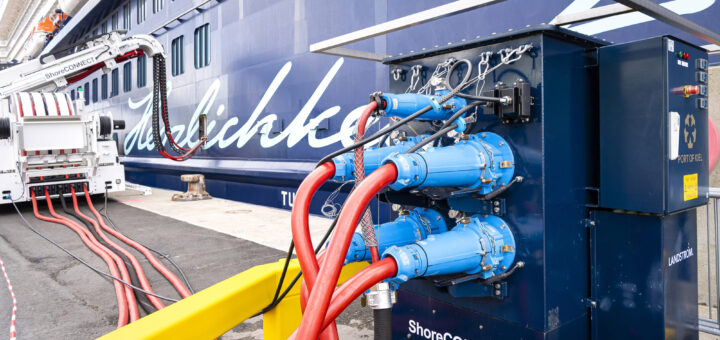
Finally, the FuelEU Regulation provides for a phased-in obligation to use shore power by 2035, with the exception of container ships and passenger vessels, which must comply by 1 January 2030.
‘From 1 January 2030, a ship berthed at a port of call falling within the scope of Article 9 of RegulationEU Regulation 2023/1804 and falling within the jurisdiction of a Member State shall connect to the shore power supply and use it to meet its entire electricity demand whilst berthed.
From 1 January 2035, a ship berthed at a port of call not covered by Article 9 of Regulation (EU) 2023/1804, which falls within the jurisdiction of a Member State, and where the berth is equipped with an available shore power supply, shall connect to that shore power supply and use it to meet its entire electricity demand whilst berthed ‘.
Shipping companies are therefore obliged to keep their vessels’ documentation up to date in all relevant ports and must specify the energy used by these vessels, whether at sea or at berth.
An auditor from the Commission’s administration will provide the methods for monitoring and collecting the various data.
Companies must retain this information and documentation for at least five years, in either paper or electronic form, enabling “the auditor to determine the greenhouse gas intensity of the energy used on board ships”.
Cost of reducing carbon emissions
The Maersk McKinney Moller Centre has studied the cost implications and consequences of implementing this European regulation, by extrapolating bunkering data for 2023 in the port of Rotterdam.
The fleet’s total consumption amounts to 26.4 MT.
If all bunkers were heavy fuel oil (HFO), they would need to be reduced by 2.4 MT of CO₂ equivalent to meet the FuelEU requirements.
This would require replacing it with auxiliary propulsion systems, energy savings or cleaner fuels. The targets could be met by 2025 by using biodiesel and bio-LNG, thereby covering 90 per cent of Europe’s decarbonisation targets. However, prices are likely to rise due to demand and production constraints. Reducing emissions by 2.4 MT would incur a cost of $350 M in 2025 and $1.7 M in 2030.
From 2030 onwards, costs are expected to rise sharply, and new fuel supply strategies will need to be planned by then.