Rail freight: developing links between Le Havre and Orléans
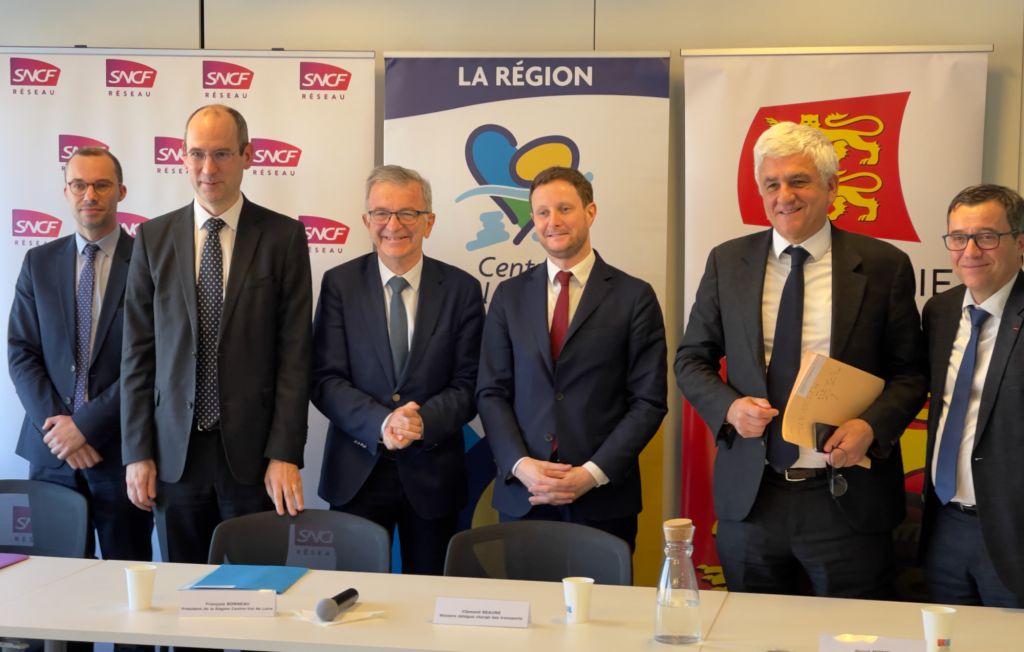
On 8 February, the Centre-Val de Loire and Normandy regions, together with the SNCF, gave the go-ahead for the construction of a new combined transport hub in Fleury-les-Aubrais.
The project, estimated at 10.3 million euros, will be funded through a number of sources:
- 50 per cent by the State;
- 40 per cent by the Centre-Val de Loire region;
- 10 per cent by the Normandy region, in support of the Port of Le Havre’s operations.
The Orléans hub is intended to supply Haropa Port in Le Havre with containers and, conversely, to enable the Normandy port area to serve the Centre-Val de Loire region via rail freight. Containers will be stored across three levels.
“Ultimately, this infrastructure will enable the transhipment of up to 150 containers per day,” states the SNCF, unveiling the project alongside the President of Normandy, Hervé MORIN, and the Minister of State for Transport, Clément BEAUNE.
For Hervé MORIN, President of the Normandy Region, this investment is the logical next step following efforts in the field of piggyback transport: “When a giant like MSC invests one billion euros in the Port of Le Havre and points out to us that there is scope for further development of rail freight, we need to send a strong signal.”
The President of the Val de Loire Region believes that this project, scheduled to begin this summer, marks a first step in the sector’s development: “This project will lead to others. The layout is designed to include two relatively short tracks initially. However, the chosen site could very well undergo a second phase of development, featuring a long track and longer trains.”
The new combined transport hub is due to come into service in early 2025, operating from the Aubrais Combined Transport Centre (CTC), initially with the capacity to accommodate two trains, each 250 metres long. Beyond that, SNCF Réseau still has the option of extending the tracks to a usable length of 750 metres – the standard length of freight trains – in order to avoid shunting manoeuvres and improve the flow of traffic.